
Quick answer. The Claude watermark is an invisible statistical signal that Anthropic embeds in text generated by Claude. It lives in the model’s word choices, not in hidden characters, and stays imperceptible to a reader. A watermark match indicates Claude was probably involved. It does not identify the user.
Since August 2, 2026, text generated by Claude can carry an invisible statistical watermark. Writers, developers, and publishers now face a practical question: what did Anthropic add, and what does it mean for content produced with Claude? This guide explains how the Claude watermark works, which models carry it, where it applies, what it proves, and whether it can be removed. Every claim below reflects Anthropic’s own documentation and the regulation that prompted the change.
What is the Claude watermark?
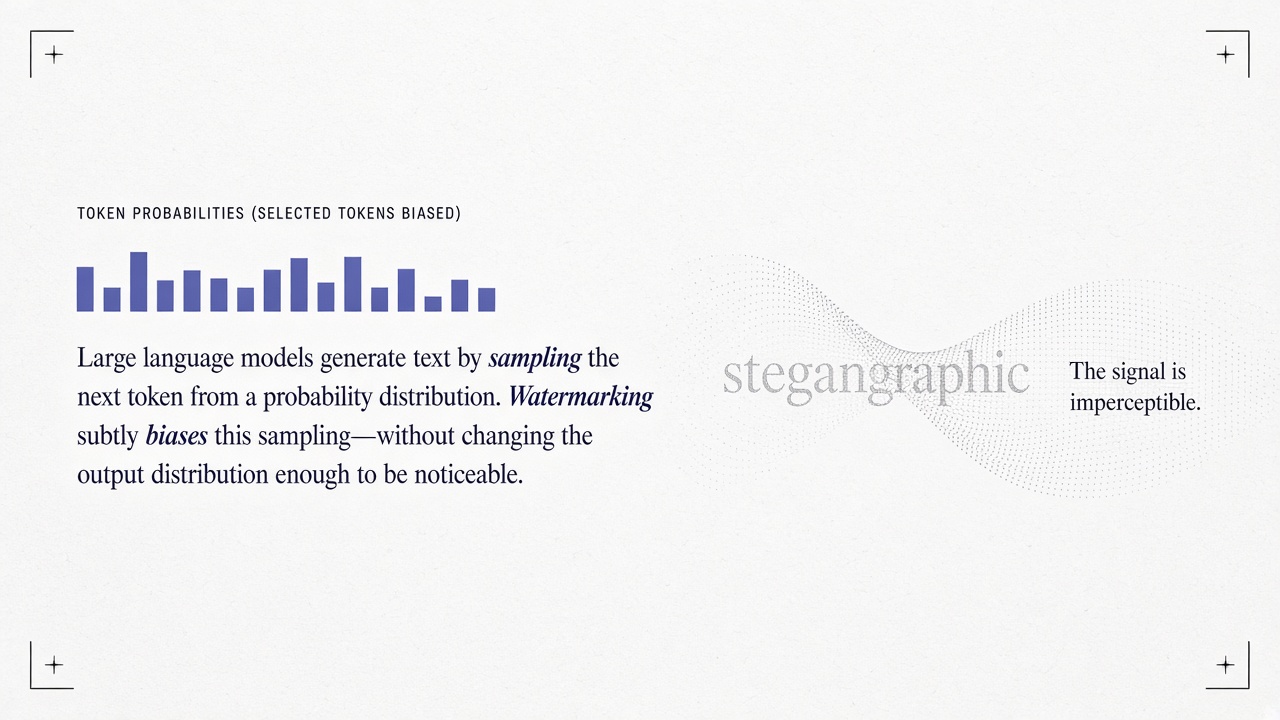
The Claude watermark is a machine-readable signal that Anthropic embeds in generated text so the text can later be identified as produced by Claude. The signal is statistical. Instead of adding a visible stamp or a hidden character, the model subtly biases which words it selects during generation, producing a detectable pattern across enough text. To a reader, a watermarked response is identical to an unwatermarked one.
Anthropic uses the SynthID Text approach that the Google DeepMind team outlined in 2024. This class of watermark traces back to the green-list and red-list scheme described by Kirchenbauer et al., which nudges token selection toward a defined subset of options in a way that a key holder can later measure. The mark is embedded at the point of generation, so it travels with the text and can survive copy-paste.
What does the Claude watermark actually contain?
The Claude watermark contains no information about the user. Anthropic states that nothing in the watermark, or its key, allows anyone to recover details about the user, their organization, or their chats with Claude. The key is shared across generations rather than issued per user or per conversation.
Because of this design, a detection result is limited in what it can claim. A match indicates that Claude was probably involved in producing the text. It does not prove authorship, does not name a person, and does not link a document back to an account. The absence of a mark does not prove human authorship either.
Statistical watermark versus invisible characters
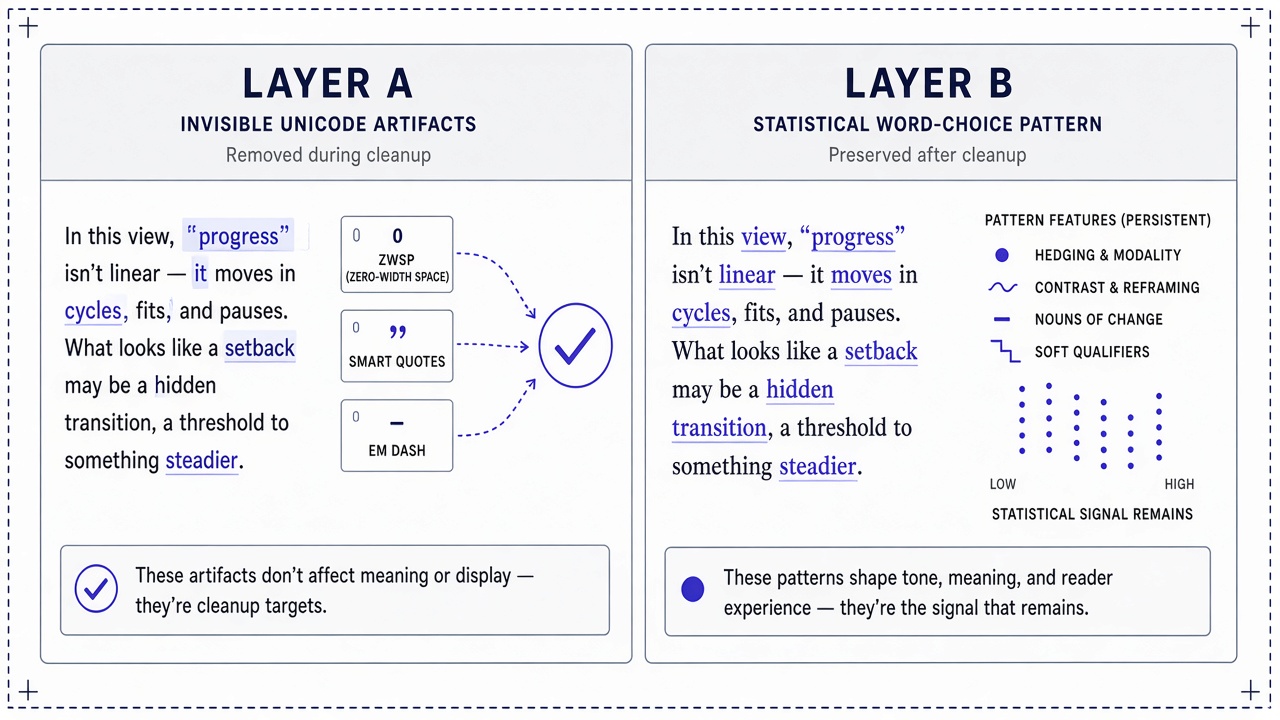
The statistical watermark and invisible Unicode characters are two different marks. Confusing them is the most common error in coverage of this topic, so it helps to separate them cleanly.
Layer A: mechanical artifacts
Layer A covers the invisible and typographic artifacts that copy out of a chat interface: zero-width spaces (U+200B), the word joiner (U+2060), the byte-order mark (U+FEFF), soft hyphens (U+00AD), em dashes, and smart quotes. These are real, and they are worth removing because they break search, code, and formatting. They are not Anthropic’s watermark. AI Text Cleaner strips that Layer A clutter in the browser. The free scan on Claude Watermark Remover does the same pass.
Layer B: the statistical mark
Layer B is the watermark itself, carried in the word choices. It cannot be seen, and it cannot be stripped by deleting characters. Removing every invisible character from a passage leaves the statistical mark fully intact, because the mark was never in the characters. This distinction determines what any cleanup tool can and cannot achieve. A rewrite through Humanize AI changes the wording, which is what can move Layer B. Character cleanup alone leaves it alone.
Which Claude models are watermarked?
As of September 2026, Anthropic lists Claude Fable 5.1 and Mythos 5.1 as supporting text watermarking, with older models being added during a transition period. The table below summarizes the marking status by model group.
Claude watermark status by model group, current as of September 2026. Anthropic updates this list as coverage expands.
| Model group | Watermark status | Note |
|---|---|---|
| Claude Fable 5.1, Mythos 5.1 | Confirmed | Listed by Anthropic as supporting text watermarking. |
| Models released on or after August 2, 2026 | Marked at launch | Watermarking is applied from release. |
| Opus 5, Fable 5 and other pre-August-2 models | In transition | Being brought in over the coming months. |
| Claude 2, Claude 3 and legacy sessions | Transition | Coverage rolling out during the EU transition window. |
Not every current Claude response is necessarily watermarked. The safe assumption is that text from a supported model, generated after August 2, 2026, carries the mark. Anthropic updates model coverage over time, so treat the table above as the current snapshot rather than a permanent list.
Where does the Claude watermark apply?
The watermark applies at the model level, so it is present regardless of which Claude surface produced the text. Anthropic applies it across the Claude API, Claude, Claude Code, Claude Cowork, and Claude for Chrome. It also applies to supported models accessed through cloud resellers, including Amazon Web Services (AWS), Google Cloud, and Microsoft Foundry.
Files are handled differently. For files, Anthropic uses the Coalition for Content Provenance and Authenticity (C2PA) standard, which attaches signed provenance metadata rather than a statistical text mark. A document therefore can carry a C2PA content credential in its metadata and a statistical watermark in any Claude-written text inside it. These are separate mechanisms with separate removal methods. Image provenance and C2PA-style checks on pictures are handled by AI Image Detector.
Why did Anthropic add a watermark?
Anthropic added the watermark to comply with the European Union Artificial Intelligence Act (EU AI Act). Article 50 sets transparency obligations that require providers of generative systems to mark AI-generated content in a machine-readable format, and those obligations took effect on August 2, 2026.
In July 2026, Anthropic signed the EU Code of Practice on Transparency of AI-Generated Content, alongside roughly 190 total signatories including other major model providers. Anthropic applies the watermark globally at launch because it does not yet have a durable way to scope marking by region. The company has stated it will continue to evaluate approaches and share updates.
Is the code Claude writes watermarked?
Code carries a negligible watermark. To produce working code, the model has little freedom to choose between equally valid options, so there is little room for the statistical signal to attach. Where an arbitrary choice exists, such as wording inside comments, the watermark can be present, but the effect on the functional code is minimal.
Translation is different. A translation produced by Claude carries a watermark, because in that case every word is chosen by Claude.
Does the Claude watermark survive editing?
Whether the watermark survives depends on how much of the wording changes. Light editing usually leaves the mark detectable, because most words are still Claude’s, and there is enough signal to measure. On text a person wrote themselves and only lightly touched with Claude, there is very little for the watermark to attach to.
A full rewrite that replaces the wording breaks the statistical pattern. Anthropic states that heavily edited or paraphrased text may no longer carry a detectable mark. At that point, the company notes, it becomes arguable whether the text can still be called AI-generated. This is why swapping a few synonyms does not work: the mark lives across the whole sequence of choices, not in isolated words.
Can you detect the Claude watermark yourself?
No. Reading the statistical watermark requires the secret key, and Anthropic holds it. Anthropic has released a watermark detection API in private preview for eligible organizations, and full technical documentation for third-party detection has not yet been published. No public tool can read the statistical mark today.
This has a direct consequence. When a page offers a “Claude watermark detector” and returns a confident percentage, one of two things is happening. It is scanning for invisible Unicode characters, which is a different mark entirely, or it is running a commercial AI-writing detector that guesses from style. Both are unreliable proxies for the statistical watermark. AI Detector sits in that second camp: a local writing-strength check, not Anthropic’s private key. ChatGPT paste cleanup and a similar Layer A scan live on ChatGPT Watermark Remover & Detector.
What watermark removal can and cannot do
What it can do: Strip every invisible character and typographic artifact (Layer A) instantly and completely with Claude Watermark Remover or AI Text Cleaner. That fixes formatting, search, and code problems, and it is safe for your own content.
What it cannot do: Guarantee that text is undetectable. The statistical mark (Layer B) only changes under a genuine rewrite, for example a pass through Humanize AI, and no tool can promise a specific result on any detector, because detectors change over time.
On the same bench: AI Detector for a local AI-writing signal, AI Image Detector for image provenance, and ChatGPT Watermark Remover & Detector when the paste came from ChatGPT instead of Claude.
Key takeaways
- Statistical mark: the Claude watermark lives in word choices, not hidden characters, and stays invisible to a reader.
- No user identity: the watermark carries no information about the user, organization, or conversation.
- Model coverage: Fable 5.1 and Mythos 5.1 are confirmed; older models are joining during the transition period.
- Regulatory cause: Anthropic added the mark to meet EU AI Act Article 50, effective August 2, 2026.
- Removal limits: character removal is complete, but only a full rewrite breaks the statistical mark, and no tool guarantees a detector result.